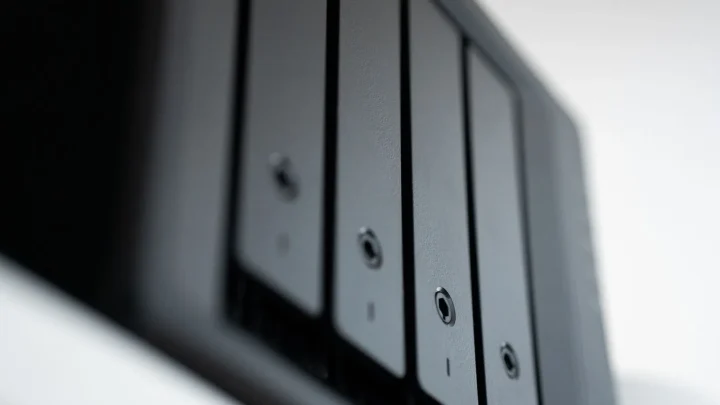
A reader emailed me last winter in a mild panic. He had locked himself out of his DS220+, held the reset button until he heard a beep, and then held it again because nothing seemed to happen. What he did not realize is that he had just triggered two completely different operations back to back.
That confusion is the heart of the whole problem. Synology gives you two reset modes on the same little pinhole button, they sound almost identical, and they do wildly different things to your box.
So let me lay them out side by side, plain and honest, so you pick the right one the first time.
What the reset button actually controls
Every modern Synology has a recessed RESET button on the back, usually next to the LAN port. You press it with a paperclip or a SIM ejector tool, and the number of seconds you hold it decides which mode you get.
The critical thing to understand is that neither mode is the nuclear "erase all my photos" option people fear. Both reset modes leave your data volume alone by default. The scary volume wipe only happens later, and only if you actively choose it during reinstall.

Mode 1: the soft reset
Mode 1 is the gentle one. You hold the reset button for about four seconds until you hear a single short beep, then release immediately.
This resets a small handful of things and nothing else. It clears the admin password back to blank, resets the network settings back to DHCP, and turns off the firewall and auto-block. Your DSM version, your packages, your users, your shared folders, and every file all stay exactly where they were.
The first time I hit a locked-out NAS at a friend's house, Mode 1 was all it took. The previous owner had set a static IP on a subnet that no longer existed, so the box was invisible on the network. Four seconds, one beep, and it grabbed a fresh DHCP address like nothing had happened.
When Mode 1 is the right call
- You forgot the admin password and just need back in.
- The NAS vanished from the network after an IP or DNS change.
- You locked yourself out with auto-block after too many failed logins.
- You want to fix connectivity without touching data or apps.
After a Mode 1 reset, you log in as admin with no password, then immediately set a new one. That blank-password window is exactly why the warning below matters.
Mode 2: the DSM reinstall
Mode 2 goes further. You hold reset for four seconds, wait for the first beep, then keep holding until you hear a second beep sequence, usually three or four rapid beeps, roughly ten seconds in.
This puts the unit into a state where it wants to reinstall DSM. On the next boot the NAS shows up as "Recoverable" or "Migratable" in Synology Assistant or at find.synology.com, and it asks you to install the operating system again.
Here is the part that trips people up. Mode 2 wipes the DSM configuration completely: users, groups, package settings, scheduled tasks, network config, and system settings all go. But it still does not delete your data volume, as long as you choose to keep it during the reinstall wizard.
When Mode 2 is the right call
- DSM itself is corrupted and will not boot properly.
- An update failed halfway and left the system in a broken state.
- You are selling or handing off the NAS and want a clean OS (paired with a volume wipe).
- Mode 1 did not resolve a deeper software problem.
The two modes at a glance
| What happens | Mode 1 (soft reset) | Mode 2 (reinstall) |
|---|---|---|
| Button hold | About 4 seconds, 1 beep | Until 2nd beep set, about 10 seconds |
| Admin password | Reset to blank | Recreated during setup |
| Network settings | Reset to DHCP | Reset to DHCP |
| DSM version and packages | Kept | Reinstalled, settings lost |
| Users and shared folders | Kept | Config lost, folders on volume kept |
| Files on your volume | Kept | Kept (unless you wipe) |
| Rough time to complete | Under a minute | 10-20 minutes |
So which one do you actually need?
Ninety percent of the emails I get are Mode 1 situations dressed up as disasters. Forgotten password, unreachable box, a bad IP change. Try Mode 1 first, every time, because it is fast and it costs you nothing.
Reach for Mode 2 only when the operating system itself is the problem. If DSM will not finish booting, throws a persistent error, or a firmware update bricked the interface, that is when a reinstall earns its keep.
A quick sanity check I use: if you can still reach the login page and the box responds on the network, the OS is basically healthy and Mode 1 is almost certainly enough. If you cannot open DSM at all, or it hangs on a loading screen for more than fifteen minutes, the OS files are suspect and Mode 2 becomes the honest choice.
One real example: a DS918+ I helped with kept showing a "System is getting ready" screen that never finished after a botched DSM 7 update. Mode 1 did nothing because the config was fine, the OS files were the issue. A Mode 2 reinstall through Synology Assistant put a fresh DSM on it in about fifteen minutes, and every file was still sitting in the volume afterward.
The data wipe nobody warns you about clearly
During a Mode 2 reinstall, some wizard flows offer to erase the drives. On a few older units and certain migration paths, an aggressive reinstall can format the volume. This is where people lose data, not from the reset button itself.
Read every screen. If the installer ever mentions erasing, formatting, or removing the storage pool, stop and confirm you have a backup. A working reset should never require you to reformat, so if it insists, something else is wrong.
And please, keep a real backup regardless. A NAS with redundant drives is not a backup, it is redundancy. For an honest primer on why those are different, Backblaze has a solid write-up on the 3-2-1 backup strategy that I point everyone toward. Synology also documents the reset behavior for each model in its official reset knowledge base article.
A clean way to think about it
Picture Mode 1 as reopening a door you got locked out of, and Mode 2 as repainting the whole room while leaving the furniture in place. Neither one throws out your furniture, but only one of them is worth the effort when all you did was lose the key.
Start soft, escalate only if you must, and read the wizard screens like your photos depend on it. Because sometimes they quietly do.
Frequently asked questions
Will a Synology factory reset delete my files?
Not by default. Both Mode 1 and Mode 2 preserve your storage pool and the files on it, because Synology only touches the small DSM system partition. You can lose data during a Mode 2 reinstall only if you actively choose to erase or format the volume in the setup wizard, so read every screen carefully.
How many beeps is Mode 1 versus Mode 2?
Mode 1 is a single short beep after holding reset for about four seconds, and you release right away. Mode 2 requires you to keep holding past that first beep until you hear a second sequence of three or four rapid beeps, roughly ten seconds in.
What is the admin password after a Mode 1 reset?
It is blank. You log in with the username admin and no password, then you are prompted to set a new one immediately. Because the firewall is also disabled at that moment, set a strong password and re-enable your firewall before doing anything else.
Do I need to reinstall DSM after Mode 2?
Yes. Mode 2 puts the unit into a recoverable state, so on the next boot it appears in Synology Assistant or at find.synology.com and asks you to reinstall the operating system. The whole reinstall usually takes ten to twenty minutes, and your files remain on the volume afterward.
Which reset fixes a NAS that lost its network settings?
Mode 1. It resets the network configuration back to DHCP, which is exactly what you want when a bad static IP or DNS change made the box disappear from your network. It does this without touching your data, users, or installed packages.